Wednesday, 30 March 2011

Illustration Friday - Toy


This weeks Illustration Friday is 'Toy'. I decided to produce a teddy bear image using Adobe Illustrator, which I created using various shapes and the paintbrush tool.

Saturday, 26 March 2011

Illustration Friday - Cultivate

This weeks Illustration Friday is Cultivate so i decided to show a farmer's field being ploughed and prepared for the planting of crops.

Sunday, 20 March 2011

Illustration Friday - Stir


This weeks illustration Friday is 'stir' so i decided to draw a bowl and spoon. I have also made it look like someone has been stirring the mixture by creating a circular motion.  

Sunday, 13 March 2011

Illustration Friday - 'Warning'


This weeks illustration is 'warning'. I decided to draw a hand with the 'exclamation' symbol in the middle which emphasizes you to stop.

Improvements:
-Look at a hand for detail
-Take a better photo
-Alter the detail on the hand e.g. the thumb
-Don't do all fingers the same size
-Improve the shading
-Use mix media

Sunday, 6 March 2011

An Analytical Review Of Francis Bacon

Francis Bacon was a figurative painter. He was born in Ireland in 1909 and died in 1992. He was well known for bold, graphic paintings showing distorted faces, emotion, feelings, pain , violent mood, showing deep inside rather than appearance.
Bacon started painting in his 20’s but not seriously. He worked in interior decorating and furniture design for a while. His career didn’t start until he was in his 30’s because he was looking for a subject that would interest him.  ‘Three studies for figures at the base of a crucifixion’ was his break through in 1944. This work and his heads and figures of the late 1940’s and 1950’s sealed his reputation. From 1950’s he painted single figures, usually male, seated as if suffering in hell. They would appear isolated in glass or steel cages. In the 1960’s he painted mainly portrait heads of his friends. He said he saw images in ‘series’ and painted variations on the crucifixion. He focussed on half human grotesque heads in ‘Heads in a Room’.
Bacon was homosexual and when his lover George Dyer died, his paintings became more personal and themed with death. The materials he used were sundeala boards which were a a cheap alternative to canvas and he painted with oil. Bacon’s technique was using rags, his hands and dust with paint and brush. He painted Triptych which is a work of art divided into three sections. He placed figures behind glass and used photographs as reference material.
He painted distorted faces and the paintings showed anger, horror, violent moods and feelings. He smeared the colours and his brush work changed to smudging and twisting. Bacon was the first to paint homosexual themes, and influence many artists like Lucien Freud.
The subject matter he painted was lovers, friends, artists and himself like Lucien Freud did. He also painted animals and hunks of raw meat . Bacon’s influences were Luis Bunell, Matthias Gruinewald, Diego Velazquez, Rembrandt, Picasso. He was good friends with Lucian Freud.
‘Triptych 1976’ sold at Sothebys for 86 million dollars. “Three studies for a portrait of Lucien Freud” sold for 23 million pounds in February 2011. In 2008 an exhibition of 60 of his works at Tate Britain travelled to Spain and then to New York.
Study After Velaquez’s Portrait Of Pope Innocent x 1953
This is a distorted version of the portrait of Innocent x by Diego Velazquez in 1650. It is One of a series of variation in Velazquez paintings in 1950’s and 1960’s. Pope is shown screaming but his voice is silenced by surrounding drapes and rich colours. The dark colours of the background give a ‘nightmare’ tone to the painting. The curtains are painted to look transparent and appear to fall through the popes face.

Painting 1946
This is a large painting. Flesh is a major part. He was attempting to paint a bird on a field and a chimpanzee in long grass but then he changed his mind. He had no intension to do this picture. He quoted ‘One continuous accident mounting on top of another’.
Two Figures
This is a painting of two male lovers making love.
Self Portrait 1973
This painting shows him suffering from a hangover or a headache and he is painting himself in a bad light. This shows he was as critical about himself as well as the models. He quoted ‘My painting is a representation of life, my own life above all, which has been very difficult. So perhaps my painting is very violent, but this is natural to me’.

Francis Bacon’s paintings shocked people because they were not in ‘good taste’. The pictures of screaming popes and nude men could upset people. I think his paintings are powerful but disturbing because of the face distortion. They show people unhappy and in pain. They remind me of scenes from horror films and they are very interesting.

Webliography
Wikipedia.org/wiki/FrancisBacon

Sunday, 27 February 2011

Illustration Friday 'Layer'


This weeks illustration Friday is 'Layer'. I have decided to create a sandwhich combining layers of bread, cheese, ham, onions and tomatoes.

An analytical Review of the work of Lucian Freud

                                                                 Lucian Freud
Lucian Freud is an artist well known for his thickly impasted portrait and figure paintings, and is known as ‘Greatest Figurative Painter Of Modern Times’. He was born in Berlin on December 8th 1922 and was the grandson of Sigmund Freud the founder of Psychoanalysis. His family moved to England when Hitler came to power because they were Jews. He became a British Citizen in 1939 and attended Dartington Hall School in Totnes, Devon and later Bryanston School. Freud studied at the Central School of Art in London and then at Cedric Morris East Anglian School of Painting and Drawing in Dedham. He also attended Goldsmiths College University of London from 1942-1943.
By 1939 he had several of his drawings published in a magazine called ‘Horizon’. He illustrated a book of poems by Nicholas Moore entitled ‘The Glass Tower’. In 1946 he travelled to Paris and then lived in Greece for Several months. Then he lived and worked in London.  When he was 17 he started to socialise with homosexual groups like Stephen Spender and Cyril Connolly. Another influence was his grandfather (the psychologist Sigmund Freud). He brought prints by Brueghel for him when he was a child. Other influences were Frank Auerbach, Francis Bacon, John Minton and Leigh Bowery who were other painters and he painted them.
In 1940 he was interested in drawing the face as in ‘Naval Gunner’.  Freud’s early paintings were associated with surrealism and were of people, plants and animals side by side. His technique was using thin paint. He painted ‘The Painters Room’. ‘The Painters Room’ was displayed in his first solo exhibition in 1944 at the Lefeure gallery. From the 1950’s he began to paint portraits and they were usually nudes. His technique changed to a thicker impasto. This was a thick application of oil paint that looked rough texture. He cleaned his brush after every stroke to stop the colours from running. He begins by drawing in charcoal on canvas. Then applies paint to a small area and gradually works outward to form thick layers. He painted naked straight women and gay men. He was noted for his slowness of painting.
He began nude female portraits in 1966 and nude males in 1977. These were painted sitting or lying. His favourite subject was Leigh Bowery. He painted in style of surrealism, realism and expressionism. . Successes include After Cezanne, ‘The Painters Room’ and ‘Girl With A White Dog’.

The Painters Room 1943
This  featured  an arrangement of objects including a stuffed zebra’s head, battered chaise lounge and a house plant and they all appeared separately in future paintings.


Girl With A White Dog 1952
This  was a portrait of Freud’s first wife – Kitty. He liked to paint “pet and owner”. This is his most famous painting. It captures the moment. He uses bold gestures. In this picture the gown slips down her right shoulder exposing a breast and Freud captures the emotions on her face at that moment which include confidence, maturity and apprehension.


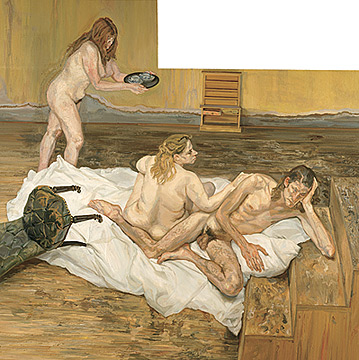
 After Cezanne 1999.
This was an unusual shape because the top left section has been joined onto the main section. You can see where the two sections join when you look closely. It was sold for 7.4 million dollars to the National Gallery of Austrailia.


Man with Rat 1977
Freud liked to paint “pet and owner”. The use of animals and people side by side. He was interested in homosexuality and painted the reality of the male form. 

Freuds paintings show the truth and the individuality of the models. Freud’s subjects were people in his life like family, friends, fellow painters, lovers and children. He said ‘The subject matter is autobiographical, it’s all to do with hope and memory and sensuality and involvement, really’. He used the same people for different paintings to develop a bond. He used friends instead of professionals because he wanted natural and real thoughts and feels of the person. He painted showing all the faults and ugliness and was well known for “capturing the moment”. Some people thought that his paintings showed humiliation and that he considered himself and his views to be always right. I think he was right to paint the truth because not everybody is beautiful.


Webliography
·         “Lucian Freud Works On Paper-Great Britain South Bank Board